An adjustable peg is an exchange-rate regime that keeps a currency near a declared parity most of the time but allows occasional realignment when the old peg becomes too costly to defend. It is often described as fixed but adjustable.
How The Regime Works
The central bank or monetary authority tries to keep the exchange rate close to a target by:
- buying or selling foreign-exchange reserves,
- adjusting interest rates,
- sometimes using capital-flow controls or prudential limits.
If external deficits, reserve losses, or inflation differentials make the old parity unsustainable, the authority can devalue or revalue the peg instead of defending it forever.
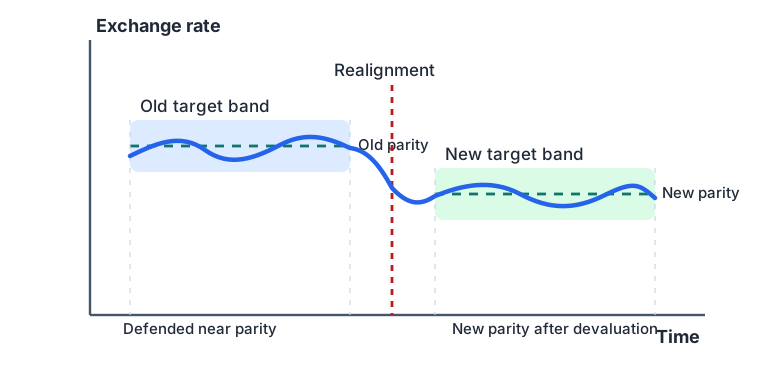
An adjustable peg holds the exchange rate near a declared parity until pressure becomes strong enough to trigger a realignment.
Why It Is Hard To Maintain
The regime sits inside the classic policy trilemma. With open capital flows, a country cannot simultaneously maintain:
- a fixed exchange rate,
- independent monetary policy,
- and fully free capital mobility.
That means domestic policy is constrained whenever defending the peg conflicts with internal goals such as growth or employment.
Expectations And Speculative Pressure
Once markets expect devaluation, defending the peg becomes even harder. A useful intuition comes from uncovered interest parity:
\[ i \approx i^* + \mathbb{E}[\Delta s] + \rho \]
If expected depreciation rises, the domestic interest rate may need to rise as well to discourage capital outflow. That can hurt domestic demand and the banking system, making the defence of the peg increasingly expensive.
Why Countries Use Adjustable Pegs Anyway
Despite the risks, governments may prefer adjustable pegs because they offer more exchange-rate stability than a pure float while retaining more flexibility than a perfectly rigid fixed rate. The trade-off is that the occasional realignment itself can become the object of speculation.
Related Terms
- Balance of Payments
- Current Account
- Exchange Rate
- Exchange Rate Regime
- Fixed Exchange Rate
- Monetary Policy