Aggregate supply is the amount of real output firms are willing to produce at different overall price levels. It matters because inflation and output depend on how production responds when demand changes or when costs are hit by shocks.
Short Run Versus Long Run
Economists usually separate aggregate supply into two ideas:
- short-run aggregate supply, which can slope upward because wages, contracts, and expectations adjust only gradually
- long-run aggregate supply, which reflects productive capacity and is often drawn as vertical at potential output
A simple short-run relationship is:
[ Y = \bar{Y} + \alpha(P - P^e) ]
where \bar{Y} is potential output, P is the actual price level, and P^e is the expected price level. When actual prices rise relative to expected prices, firms may temporarily produce more.
What Shifts Aggregate Supply
Short-run aggregate supply shifts when production costs or expectations change. Common examples include wages, energy prices, taxes on inputs, and productivity shocks.
Long-run aggregate supply shifts when the economy’s productive capacity changes through labor-force growth, capital accumulation, technology, and institutions.
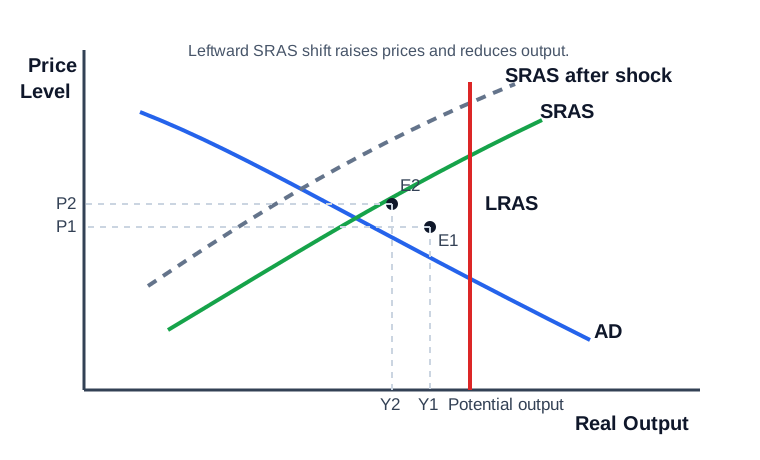
Aggregate supply matters because inflation and real output depend on where aggregate demand meets short-run costs and long-run productive capacity.
Why Policymakers Care
Aggregate supply determines how demand stimulus translates into output versus inflation. If the short-run aggregate-supply curve is flat, demand changes mostly affect output. If it is steep, the same demand shock produces more inflation and less extra output.
Supply shocks complicate stabilization policy because they can lower output and raise inflation at the same time.